Skip to content


Quick summary before we start:
This blog talks about what answer engine optimisation is, how it’s not really the same thing as regular SEO anymore, why AI Overviews and ChatGPT are eating into normal search traffic, how these tools actually decide what to cite, whether schema markup still helps or not, and some simple steps small businesses can follow to slowly start showing up in AI answers.
So What Is Answer Engine Optimisation, Really?
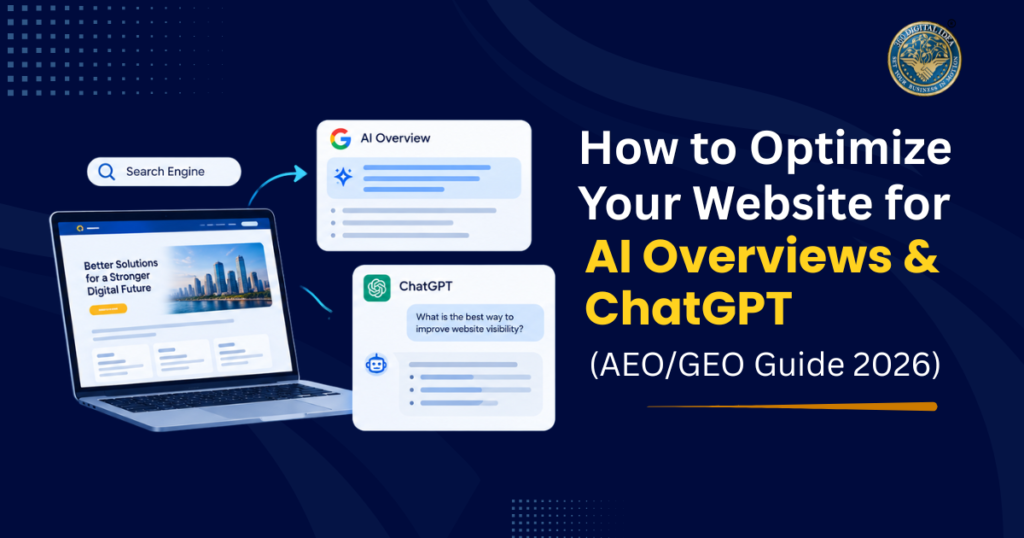
Answer engine optimisation, which people usually just call ‘AEO’, is basically about setting up your website so tools like ChatGPT or Google’s AI Overviews pick your page as the source when they answer someone’s question. It’s not really about being number one on a search page anymore. It’s more about getting picked or quoted inside the answer itself. Sometimes the person never even clicks your website. They just read the answer and move on.
A few years back, search worked pretty simply. You typed something in, got a bunch of blue links, and clicked one that looked right. Now a lot of the time, an AI-written summary just sits right on top and answers the question before you scroll down at all. So if your page isn’t one of the ones feeding that summary, you basically don’t exist for that search, even if you were ranking fine the old way.
Is GEO SEO the Same Thing as AEO?
Generative engine optimisation, or GEO SEO, as some people call it, is kind of the bigger term here. It covers pretty much every way of showing up on AI platforms: ChatGPT, Gemini, Claude, and all of that. Answer engine optimisation sits inside that, more focused on the exact moment an AI tool grabs a source to quote for a fact or a recommendation.
Honestly, most agencies just use ‘generative engine optimisation’ and ‘answer engine optimisation’ to mean the same thing, and for a business owner, it probably doesn’t matter much which word you use. What matters is that GEO SEO and AEO both want the same result. Get your brand named inside the AI answer instead of sitting somewhere on page two of Google where nobody scrolls.
Why Do AI Overviews’ Optimization Actually Matter Now?
Here’s the part that’s hard to brush off. AI Overviews now show up on close to half of Google searches in the US, and that number was only around 6% about fifteen months back. Google has said its AI Overviews reach over a billion people every month. Chat GPT is in a similar spot too, with weekly users somewhere in the hundreds of millions.
| Metric | Data point | Source |
| AI Overviews showing up in US Google searches | around 48-50% (early 2026) | BrightEdge |
| Google AI Overviews monthly users | over 1 billion | |
| Organic click rate drop on AI Overview searches | fell from 1.76% to 0.61% | Seer Interactive |
| People using ChatGPT-type tools for local businesses | 45%, up from just 6% last year | Industry survey data |
| Marketers saying AI search is their biggest 2026 problem | 65% | Goodfirms survey |
That click-drop row is the one business owners actually feel. People just aren’t clicking through as much because the AI already told them what they wanted. That’s really why AI overview optimisation stopped being some optional extra thing and became something people are putting real budget into now.
How Do AI Overviews Even Pick What to Cite?
Ranking well on Google still helps, don’t get me wrong, but it’s not the whole game anymore. A page sitting at the top spot has around a 58% chance of getting picked for an AI overview. By spot ten, that drops to something like 14%, based on Growth Memo’s numbers. But here’s a weird bit: close to 40% of AI Overview citations come from pages that aren’t even in the top ten.
So that tells you AI overviews aren’t just skimming the top ten and grabbing one. They’re also picking up pages that answer the question clearly and directly, even when the page isn’t ranking that high otherwise. Being clear and specific seems to count for a lot here, sometimes more than just having an old, trusted domain.
ChatGPT Doesn’t Work Like Google’s AI Overviews
This is where a lot of people mess up. They treat ChatGPT and Google AI Overviews like the same target, but they’re not. ChatGPT leans more on something called semantic authority, basically how often and how consistently your brand shows up across the whole internet, not just your own site. Perplexity works differently again, more like a live search tool pulling in freshly indexed pages.
Only about 2% of URLs get cited across AI Overviews, ChatGPT, and Perplexity all at once. Most citations, over 90% actually, show up in just one of these tools and nowhere else. So if your plan is only built around Google AI Overviews optimisation, you’re probably missing ChatGPT completely, and that needs its own thinking.
Answer the question first, and explain after.
The biggest fix, and probably the easiest one, is just answering the question in the very first line of a section, then explaining more after that. AI tools tend to grab whatever clear chunk of text they find first, so if your answer is hiding three paragraphs down after some long intro about your company, it’s probably not getting picked up at all.
Just to be clear, this next bit is a made-up example, not a real case, just to explain the point. Say a bakery in Delhi has a page about custom cake pricing. A weak version starts by talking about how much they love baking and their story before finally mentioning price somewhere near the bottom. A better version just opens with something like, “Custom cakes in Delhi usually cost between this much and that much, depending on size and design, and explains the rest after. That first line is what an AI tool can actually lift and use.
Does Schema Markup Still Help or Not?
Schema used to feel like some kind of shortcut to getting cited by AI. That’s not really true anymore, and it’s worth just saying it plainly. A study by Ahrefs in May 2026 looked at close to 1,900 pages that added schema and found basically no real citation boost across Google AI Overviews, AI Mode, or ChatGPT compared to similar pages without it. Another test even found some AI tools only read the visible text on a page and skip the hidden schema code entirely.
That doesn’t mean dropping the schema completely, though. It still helps search engines and AI tools understand what your business actually does, and it does help your brand get recognised as an entity. Also worth knowing, Google removed FAQ rich results from normal search back in May 2026, so don’t bother adding FAQ schema just to chase that old dropdown look. Only add it if the questions and answers are actually real and visible on the page.
| Schema type | Where to use it? | Still worth adding |
| Organization | Homepage, about page | Yes |
| Local Business | Any business with a physical address | Yes |
| Article / Blog Posting | Blog pages | Yes |
| FAQ Page | Pages that actually have real Q&A content | Yes, but only if it matches |
| Product | Product pages | Yes |
Get Mentioned Outside Your Own Website Too
This is the part most small businesses just skip over, and it’s probably the biggest gap out there. Brands are about 6.5 times more likely to be cited on other websites, listicles, review pages, and forums than on their own website content, according to Airops research. Mentions of your brand across the internet actually match up with AI overview appearances way more than backlinks do.
Sites active on Reddit and Quora have around 4 times better odds of getting cited. Businesses that show up on review platforms like G2, Trustpilot, or Yelp see close to 3 times better odds too. So basically, getting mentioned and reviewed outside your own domain isn’t just a side task anymore. It’s kind of a core part of the job now.
What’s the Best AEO Strategy for Small Business Owners?
If you’re running a small business without some big content team behind you, you don’t have to fix everything at once. The best AEO strategy for small business owners is usually just starting small and staying at it, rather than trying to overhaul the whole site in one go and burning out.
| Step | What to do? |
| 1 | Write down 10-15 questions your customers ask before buying |
| 2 | Answer each one in the first line of its own page or section |
| 3 | Add LocalBusiness and Organization schema; make sure the details actually match your site |
| 4 | Claim and fill out your Google Business Profile properly |
| 5 | Get listed and reviewed on a couple of relevant platforms like Yelp, G2, or Trustpilot |
| 6 | Type your own key questions into ChatGPT and Google AI Overviews and see who gets cited |
| 7 | Go back and update your old pages instead of only writing new ones |
Doing three or four of these consistently works better than trying to nail all seven once and then forgetting about it for six months. A lot of businesses around Delhi, and honestly everywhere, end up going to agencies for proper AEO services just because checking citations across all these AI tools by hand every month takes actual time, and that’s usually where the real value sits.
Mistakes That Quietly Mess Things Up:

A few things keep showing up again and again. Writing a long intro before actually answering the question buries the one part AI tools want to grab. Adding schema that doesn’t match what’s actually on the page confuses things more than it helps and can go against you after recent updates. Only polishing your own website while ignoring reviews and mentions elsewhere means missing the bigger opportunity.
Another common one, treating every AI tool the same way. A page built just for Google AI Overviews might do nothing at all for ChatGPT, since they barely overlap on what they cite. Just testing your own questions across a few different tools tells you way more than guessing ever will.
How Do You Know If Any of This Is Working?
Normal rank tracking tools won’t show you this stuff. You kind of have to manually type your target questions into ChatGPT, Google AI Overviews, and Perplexity now and then and just note down if your brand shows up and how often. Some newer tools do this automatically now, but even checking by hand once a month beats not checking at all, especially since only around 14% of marketers currently track AI citations, even though 43% call it a top priority this year.
Also keep an eye on your AI referral traffic in analytics. It’s usually a small number, but those visitors tend to convert better than regular traffic, probably because they’re arriving already trusting whatever source named you.
Wrapping This Up
Search just isn’t working the same way it used to, and that’s not changing back anytime soon. Answer engine optimisation and generative engine optimisation aren’t some passing trend; they’re slowly becoming just how people find businesses now. Schema helps things stay clear, but it won’t win you citations by itself. Writing answers directly and getting mentioned outside your own website matters more than most sites realise right now. Start with the questions your customers already ask, answer them plainly, and build up some presence on the places AI tools tend to trust. That’s really the best AEO strategy for small business owners at this point – nothing too complicated, just steady, honest groundwork done consistently.
FAQs
Q1. Is AEO going to replace SEO?
Not really, no. Regular SEO still brings in most website traffic right now. AEO and generative engine optimisation work alongside SEO, not instead of it, since a solid SEO base is still what feeds into whatever AI ends up citing.
Q2. How long before answer engine optimisation actually shows results?
Most businesses see some early citation activity within a few months, but full results usually take longer, kind of similar to regular SEO timelines.
Q3. Should I hire someone for AEO services or just do it myself?
For smaller stuff like fixing page structure or claiming review profiles, you can do it yourself. Tracking citations across multiple AI tools regularly is usually where people bring in outside AEO services, mostly because of the time it eats up.
Q4. Does GEO SEO work the same for every kind of business?
Not exactly. Service businesses get more out of local schema and reviews, while content-heavy sites get more out of answer-first writing. The basic ideas behind generative engine optimisation stay the same, but what you prioritise shifts depending on the industry.
Q5. Is schema markup even worth adding anymore?
Yes, it’s still worth it; just don’t expect it to guarantee citations on its own. Add it because it describes your page correctly, not just to chase AI visibility.
Q6. Can a small business actually compete with big brands here?
Yes, more than people expect, actually. AI tools often just cite whatever answers the question clearly, no matter how big the site is, which is part of why the best AEO strategy for small business owners is about answering specific questions well, not chasing broad authority.
Q7.Should I focus on Chat GPT first or Google AI Overviews first?
Depends where your customers actually search. For most local businesses, that’s still Google AI Overviews, just because it touches so many more searches right now.