Skip to content

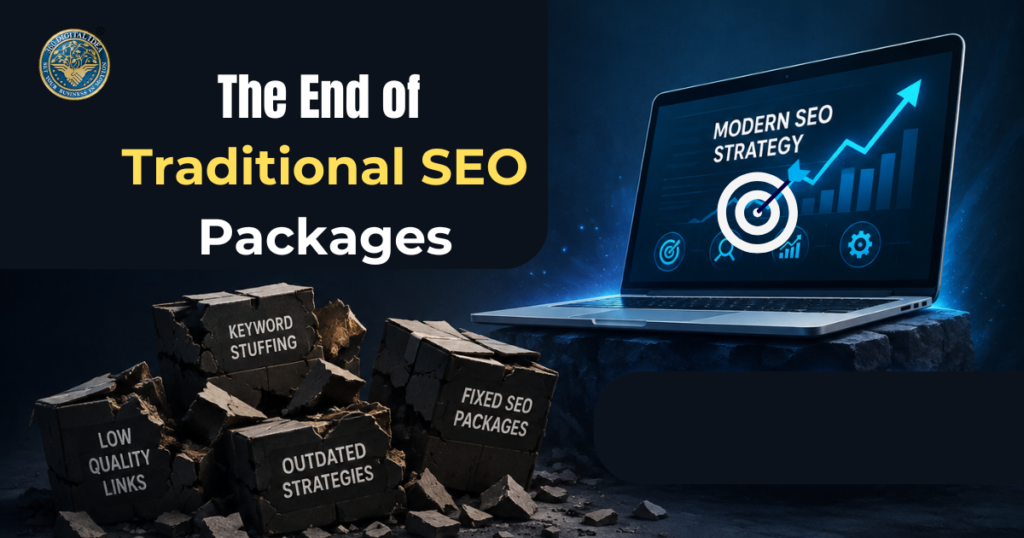
If you have ever bought a traditional SEO package, you know how it works. Ten keywords. Four blog posts a month. A couple of backlinks. A report full of graphs that nobody on your team really looks at. You pay the same money every month. It does not change much even if your business changes a lot.
This kind of package is not working like it used to. That does not mean SEO stopped mattering; it still matters. Google still gets billions of searches every day. But the old package, the one built around a fixed list of keywords and a fixed number of links, was made for a different kind of search engine. People do not search that way anymore. In 2026, this old package no longer meets the job it used to.
This blog talks about why these old SEO packages are losing their value, what actually helps you get found now, and what your business should focus on instead. That means Google, but it also means AI Overviews and chatbots, since a lot of people use those to look things up too.
Why traditional SEO packages are losing their value?
The old package was built on one simple idea. Rank for keywords, get clicks, get customers. That worked fine back when the only way to find something online was a page of blue links.
That is not how search works now. AI Overviews and AI Mode show up more and more inside Google results. This changes how people find things, and it cuts down on the clicks websites used to get. On top of that, AI Overviews cut clicks on the top search result by about 34.5 percent on average. Pew Research found something close to this too. When an AI summary shows up, people click the normal result a lot less. Around 8 percent of visits go there, compared to 15 percent when there is no AI summary on the page.
So the old promise, rank number one and the traffic will come, does not really hold up anymore. You can rank well and still get fewer people on your site than before.
There is another part of this that matters a lot. AI tools answer questions using websites that look trustworthy. So AI has not really replaced the need for a good online presence; it just changed what “good” means. And a big part of what makes a business look trustworthy now comes from things a normal SEO package does not touch at all. Things like your reviews, your reputation, and what people say about you online.
What does a traditional SEO package usually include?
To see why this model is getting old, it helps to look at what most agencies actually give you in these packages.
| What you get | What it is supposed to do | Why it is not enough now |
| Keyword research list | Target search terms that get volume | People now type longer, more natural questions, a lot of it inside AI chat tools |
| Monthly blog posts | Add fresh content for rankings | Thin, generic posts do not usually get picked up by AI systems |
| Backlink quota | Build authority through links | Cheap, bulk links can get flagged and do more harm than good |
| Technical audit | Fix crawl and site speed issues | Still useful, but it is only a small piece of the picture now |
| Ranking report | Show where you sit for keywords | Rankings without clicks or trust do not turn into real lead |
None of these things are bad on their own. The problem is that a package built five or six years ago treats this list as the whole plan. Now it is really just a starting point.
What search engines and AI tools actually reward now?
Search in 2026 is not just one place. People search on Google, but also on ChatGPT, Perplexity, TikTok, and Amazon. Getting seen now depends on being a brand people know, making content worth pointing to, and showing up in the different places people ask questions, not just ranking well on one search engine.
The businesses doing well with this shift tend to have a few things in common.
Brand recognition matters more than keyword count. Brand has become one of the biggest things that decides visibility. Not in the old sense of being a ranking factor, but as a sign that tells AI systems whether your content can be trusted and shown. When a few different sources say the same kind of thing, AI tools tend to pick the brands they already know and see mentioned in other places.
Getting cited matters as much as ranking used to. For a long time, the big question in SEO was where you rank. Now there is another question just as big, are AI systems citing you as a source people can trust. There is also early data showing that brands who get cited in AI answers see more people search their name directly after that. So getting cited helps people notice your brand even without a click.
Trust signals carry more weight than before. Websites with strong brand signals and a presence in different places tend to hold up better when algorithms change. E-E-A-T, which stands for experience, expertise, authority, and trust, keeps getting more important. It is not just an SEO job anymore. It touches content, PR, and how your brand shows up everywhere.
Look at all three points together, and none of them are really about keyword count or backlink numbers. They are about reputation. What people say about your brand. What shows up when someone searches your name. How your reviews read. Whether your business looks trustworthy when someone checks you out. This is the part online reputation management deals with, and it is the part a standard SEO package usually skips.
Old SEO thinking compared to what actually works now
| Old SEO thinking | What actually helps visibility in 2026 |
| Rank for a list of keywords | Get cited as a trusted source by AI tools |
| Buy backlinks in bulk | Build real brand mentions and press coverage |
| Post one blog a week, on any topic | Post less, but write from real experience and real data |
| Focus only on the website, ignore reviews | Manage and grow reviews on Google, Trustpilot, and other sites |
| Track keyword rankings only | Track brand mentions, review sentiment, and AI citations too |
| Treat SEO as one team’s job | Treat online visibility as a mix of SEO, PR, and reputation work |
This is not saying SEO is dead. It is not. SEO in 2026 has changed to focus more on what people actually want: good content, technical work, and real authority. The point here is simpler than that. The old package, sold as a fixed bundle of keywords and blog posts, was not built for what earns trust today.
The part most SEO packages leave out
A business can have a clean, well-built website and still lose customers because of what shows up when someone searches the company name. A bad review sitting on the first page. An old news story that does not match the business anymore. A complaint from a former employee on Glassdoor. None of that gets fixed by writing more blog posts or buying more links.
This is where reputation management and search visibility start to overlap. If AI systems and search engines now care about trust, reviews, and brand signals as much as technical SEO, then ignoring your online reputation while paying for an SEO package leaves a big gap open.
At Build Brand Better, this is what we work on every day. We are an online reputation management company based in Delhi NCR, and our work sits right in this overlap between SEO and reputation. We help businesses and individuals with things like:
Pushing down or removing bad search results that hurt trust
Managing and growing reviews on Google, Glassdoor, Trustpilot, and other sites
Watching brand mentions so problems get caught early, before they spread
Building a stronger online presence through personal and business branding
Handling crises before they turn into long-term damage
Search your own business name right now. What shows up on the first page? That answer probably matters more for your visibility in 2026 than another round of blog posts written just to hit a number.
What to check before signing another SEO package?
Before you renew or sign a standard SEO package, ask yourself a few plain questions first.
Does this plan look at anything besides keyword rankings, like review sentiment or brand mentions?
Does it include any reputation work, or does it only look at the website?
Is the content based on real experience and real data, or is it just filler meant to hit a word count?
Would this plan still work if a big part of your traffic came from an AI chat tool instead of a Google search page?
If most of your answers come back no, the package you are looking at was probably built for how search worked around 2019, not how it works now.
A better plan mixes technical SEO with active reputation management. A clean site and good content still matter; that part has not changed. But what Google, ChatGPT, and Perplexity find when they look at your whole brand matters just as much now, not just what they find on your website.
Get a clear picture of where you stand
The fastest way to know if your online presence is ready for how people search today is a proper check. One that looks at your search results, your reviews, and your brand mentions together, not just the technical side of your website.
Build Brand Better offers a free reputation call to help you see what is actually helping your visibility and what is quietly working against it. You can call our team directly at +91 99716 87251, or reach out through our business solutions or individual solutions pages, based on what you want to protect and grow.
Traditional SEO packages are fading out as the main way businesses stay visible online. What is taking their place is not a big secret. It comes down to trust, reviews, brand mentions, and a reputation that holds up no matter where someone searches your name.